What actually goes wrong with CWI in Welsh properties?
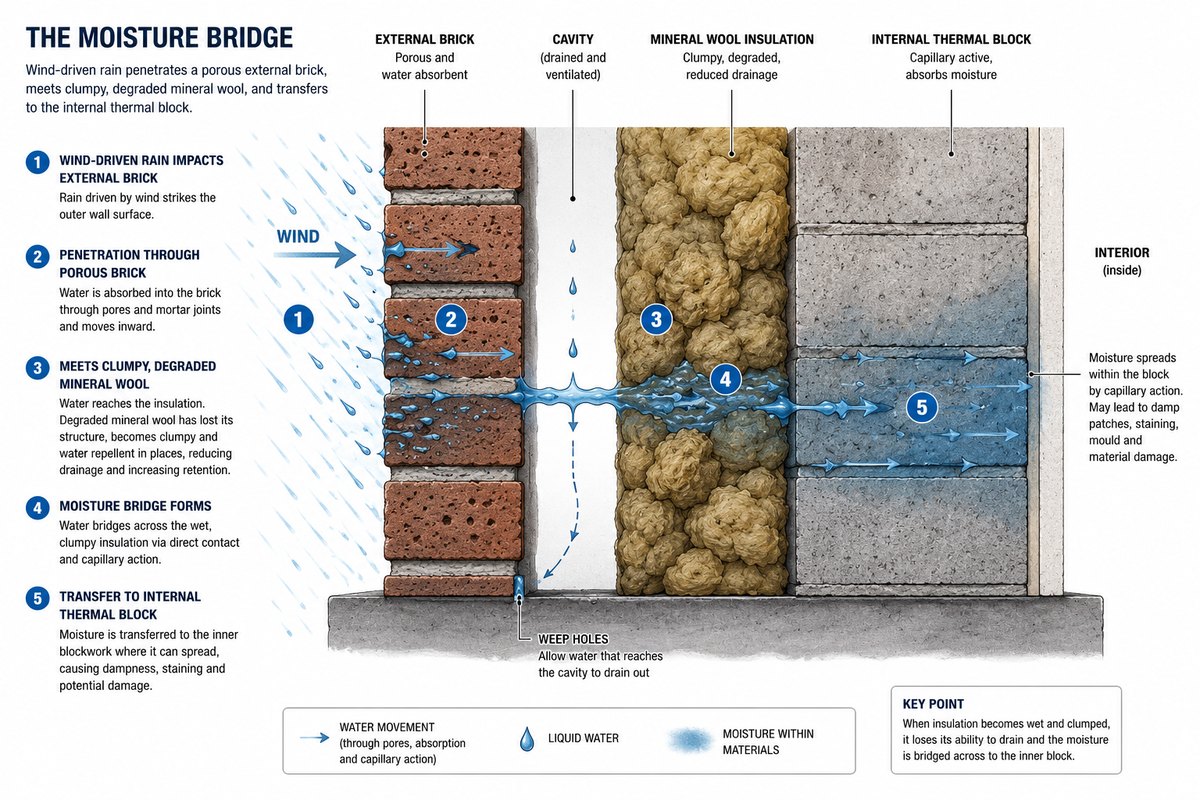
Failed cavity wall insulation in Wales is predominantly triggered by wind-driven rain saturating external brickwork, allowing moisture to bridge across retrofitted mineral wool or urea-formaldehyde foam directly to internal plaster.
Wind-driven rain
Based on the approximate wind-driven-rain levels defined within the Building Regulations (England) Approved Document C — site preparation and resistance to contaminants and moisture — the UK is divided into four exposure zones. The amount of wind-driven rain is an estimate, given in litres/m² per spell, and site-specific calculations to BS 8104:1992 can assess exposure more accurately.
The concept of a cavity wall is simple: a built-in air gap between the outer brickwork and inner leaf, designed to stop water penetrating the interior. Moisture hits the external wall, runs down the inside of the cavity, and escapes through weep holes.
When you pack that gap with mineral wool, foam or polystyrene beads, you remove the safety buffer. If your property is in an area of high exposure, or has minor defects in the external masonry, the insulation becomes saturated. It then acts as a bridge, drawing damp straight through to your internal plaster.
We regularly see three main triggers for installation failure:
- Unsuitable exposure mapping: the property sits in a high wind-driven-rain zone where retrofitted CWI should never have been approved.
- Structural pre-conditions: the insulation was blown into a cavity already contaminated with dropped mortar (snots), wall-tie corrosion or rubble.
- Substandard workmanship: incorrect injection patterns left large voids where cold air circulates, causing sharp temperature drops and severe condensation.
Warning signs your cavity wall insulation has failed
The symptoms of defective insulation rarely appear overnight. They develop slowly over several winters, often showing as:
- Symmetrical damp patches: dampness that mirrors the injection-hole pattern on your external brickwork.
- Persistent skirting-level mould: black mould (Stachybotrys chartarum) forming along the base of external walls, even in well-ventilated rooms.
- The “fridgeline” effect: walls that feel icy to the touch, indicating the internal filling has slumped into a sodden, wet mass at the bottom of the cavity.
- Spalling brickwork: external bricks flaking or cracking because the wet insulation behind them freezes and expands during winter.
The first steps to resolving a failed installation
If you suspect your cavity wall insulation is failing, do not jump straight to hiring an extraction firm or signing contracts with a claims company. A structured approach protects both your consumer rights and your bank balance.
1. Track down the original installer
Your first port of call should always be the firm that carried out the work. Under UK consumer law, they are responsible for investigating complaints and putting defects right. If you are unsure whether the work was funded under an old Welsh Government scheme (such as the historical Nest or Arbed programmes), you can contact the Welsh Government directly — though data-retention limits mean records for installations completed over a decade ago may no longer be held.
2. Leverage the 25-year guarantee
The vast majority of government-backed installations completed after 2013 carry a 25-year structural guarantee. The most common provider across Wales is the Cavity Insulation Guarantee Agency (CIGA).
If the original installer has gone out of business — an incredibly common scenario in the green-energy sector — CIGA is legally required to step in, provided your certificate is active. They dispatch an independent surveyor to assess the cavity with a borescope camera. If the claim is validated, CIGA covers insulation extraction and internal damp rectification up to the terms of the guarantee.
Navigating CIGA deadlocks and rejections
CIGA claims are not always straightforward. A common point of friction is a CIGA surveyor attributing your damp to maintenance issues — cracked render, faulty pointing or leaking gutters — rather than the insulation itself. If you hit a brick wall, understand the escalation routes:
| Dispute type | Resolution body | Next practical step |
|---|---|---|
| CIGA rejection | Independent arbitration | Request a formal “deadlock letter” from CIGA to trigger independent dispute resolution. |
| Insurance-backed scheme failures | Financial Ombudsman Service (FOS) | Escalate the case if your alternative insurance provider handles the claim unfairly. |
| Private / unregulated disputes | Trading Standards / Citizens Advice | File a consumer-rights report under the Consumer Rights Act 2015. |
What if you have no valid guarantee?
Discovering that your property lacks an active CIGA or insurance-backed certificate leaves you in a tough position — the liability for fixing the property falls directly on you. Before paying a private contractor thousands for an emergency extraction, get an independent, RICS-qualified building surveyor to inspect the property. Removing insulation is an invasive, multi-day process using industrial vacuum units and compressed-air lances. If your damp is actually caused by a leaking roof valley or breached damp-proof course (DPC), pulling the insulation out won’t solve it.
The Welsh Government Home Improvement Loan Scheme: interest-free (0%) loans made available through local authorities (such as Newport, Cardiff or Caerphilly councils) to help homeowners make properties safe, secure and warm.
Warning: the risks of claims management companies
Many homeowners across the South Wales Valleys have been targeted by doorstep canvassers or cold-callers from Claims Management Companies (CMCs) promising “no-win, no-fee” compensation for faulty insulation. While some are legitimate, the sector is rife with predatory tactics — contracts that hand over a large percentage of any payout, or complex legal battles with hidden fees.
Before speaking to a CMC, verify their credentials against the Financial Conduct Authority (FCA) register, and make sure you have exhausted the free CIGA arbitration routes first.
Professional organisations to contact for support
- CIGA (Cavity Insulation Guarantee Agency): verifying certificate status and initiating formal claims.
- Citizens Advice Consumer Service: free, confidential advice on your statutory consumer rights.
- Ofgem: the regulatory body overseeing the old Energy Company Obligation (ECO) frameworks.
- RICS (Royal Institution of Chartered Surveyors): to source an independent local surveyor with no financial interest in whether you pay for extraction.
The bottom line
Cavity wall insulation remains a valid weapon against high heating bills, but it was never a one-size-fits-all fix. If your house sits on an exposed Welsh hillside or faces heavy maritime winds, filling that air gap can backfire. If you are dealing with moisture issues, act quickly before structural wet rot settles into your floor joists. Check your paperwork, map out your guarantee status, and focus on clearing the cavity through verified, professional channels rather than rushing into expensive litigation.